Scope, responsibilities and evidence for a controlled partnership.
Buyers & sellers
Marketplace and internal Android journeys.
Organizations & operations
Tenant workspaces and specific platform controls.
Institutional review
Manual pilot implemented; production activation remains disabled.
Consórcio Soberano is a technology platform for transactions between third-party cota holders and prospective buyers. It brings listing preparation, review, offers and documentary tracking into a controlled journey. It is not presented as an administradora de consórcios, and own-account purchase/resale is not the approved working model.
This guide separates an existing product journey from a proposed institutional connection. It is an explanatory document, not a commercial offer, institution mandate, regulatory certification or promise of automated transfer. Any partnership requires agreed scope, authority, responsibilities and acceptance criteria.
Scope, responsibilities and evidence for a controlled partnership.
Seller
Prepares a listing and supplies evidence; controls only authorized own records.
Buyer
Compares cotas and proposes through the platform; no default access to seller documents.
Partner organization
Operates an agreed branded workspace; branding grants no cross-customer authority.
Institutional reviewer
Assesses authorized facts under a named, time-limited case/field/document mandate.
Soberano operations
Applies platform controls; cannot replace the administradora’s decisions.
All 5 participant roles
Participant
Purpose
Boundary
Seller
Prepare a listing and share required evidence
Controls only authorized own records
Buyer
Compare cotas and make protected offers
Cannot access private seller documents by default
Partner organization
Operate an agreed branded workspace
Branding does not confer regulatory or cross-customer authority
Institutional reviewer
Assess specifically authorized facts
Named, time-limited access by case, field and document
Soberano operations
Apply platform controls and support the journey
Cannot replace the administradora's required decisions
A separate panel supports operational work. Partner branding can be used with Soberano fallback. The intended self-service scope is display name, logo, brand color and support contacts; domains, legal identity, team permissions, fees and suspension remain controlled setup tasks. A complete connection to the partner's existing systems is not assumed.
Scope, responsibilities and evidence for a controlled partnership.
1
Prepare and submit
Statement or manual entry, corrected values, documents and applicable terms. Extraction is not approval.
2
Operational review
Current source, identity/authority and required checks remain server-controlled.
3
Separate publication and negotiation decisions
Approved visibility does not remove the protected negotiation or transfer requirements.
The seller uploads a statement or enters cota information and supplies required documents.
The seller reviews extracted/entered data, sets the asking price and confirms applicable terms.
Operational checks assess source, identity/authority and applicable cota/transfer conditions.
An approved listing can become visible; eligibility to negotiate retains its own checks.
A buyer compares facts and submits an offer through the platform.
Acceptance, fees, contracts, payment and the administradora's registration each retain separate evidence and controls.
Document upload or extraction is not approval. Signature, payment acknowledgement or public proof is not ownership transfer. Cancelled/excluded cotas require their applicable rights and institution rules; they must not be marketed as automatically usable credit. Unsupported cases must be identified explicitly.
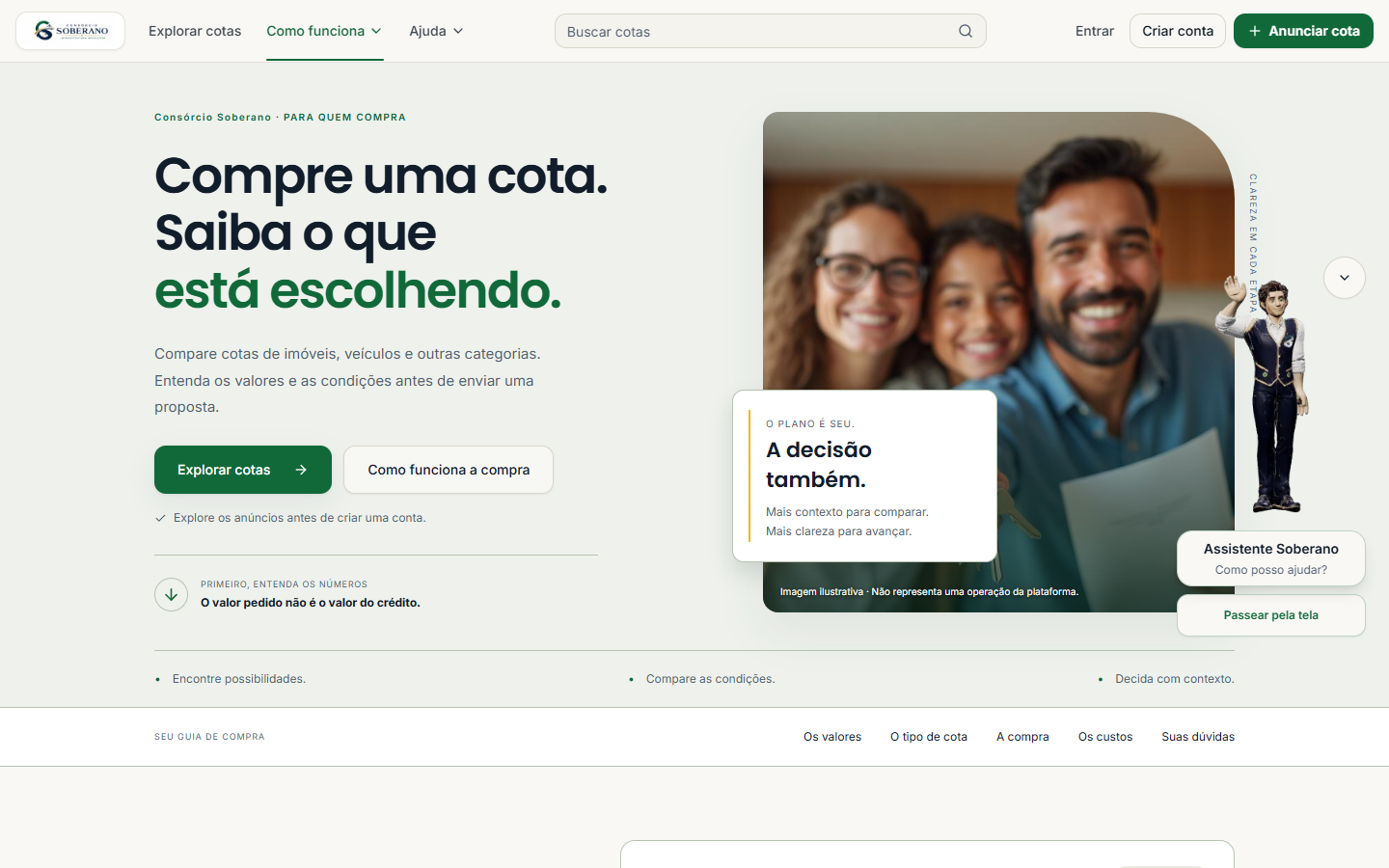
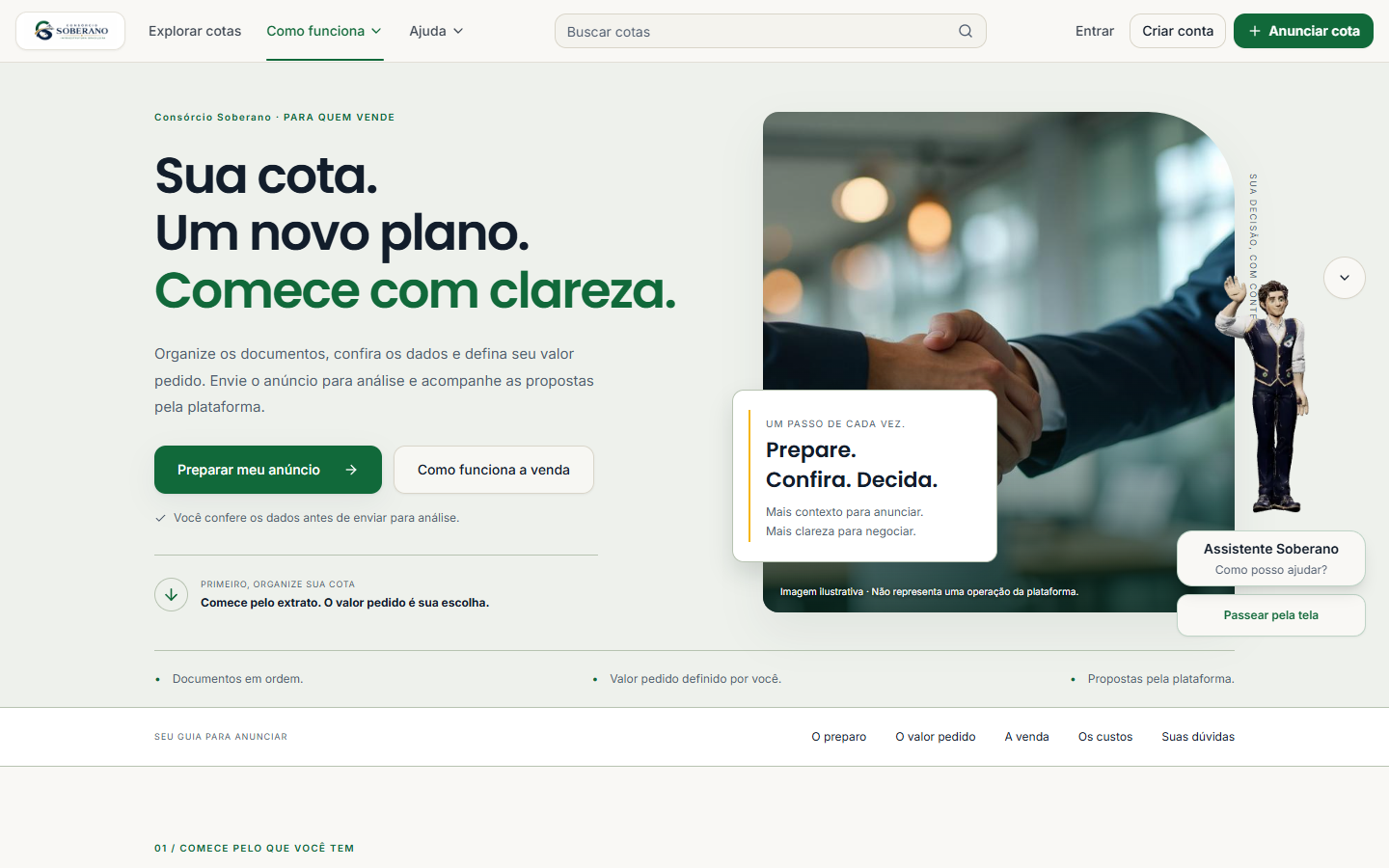
Interface reference
Historical guest review
Historical local guest-page capture; not a fresh served-version certification.
Scope, responsibilities and evidence for a controlled partnership.
Transaction consideration
The buyer/seller transaction amount is not automatically platform revenue.
Platform revenue
Use authoritative quotes and immutable accepted fee snapshots; commercial plans require their agreed scope.
External obligations
Administrator costs are separate. Unknown is not zero; draft tariffs do not activate collection.
The asking price is what the seller requests, not the credit amount. Amount already paid, outstanding balance, installments and credit references are separate facts. Missing information is shown as unknown rather than zero. Historical statement values are not necessarily current balances.
Platform fees must come from the authoritative quotation and accepted version. Administrator transfer charges, remaining installments and other contractual costs are separate. No platform buyer fee, where applicable, does not mean the purchase has no other costs. A fee preview, accepted fee, paid amount and invoice are distinct records.
Intermediation, subscriptions, white-label licensing and implementation/services are commercial streams to be agreed for the relevant scope. This guide sets no binding price, partner commission, payout schedule or tax rate. Draft external tariffs do not activate collection or change accepted negotiations. Fiscal treatment and invoicing require validated accounting decisions.
Partner guide Passport and optional ConsorcioBlock
Partner reference2026-10-29
Passport and optional ConsorcioBlock
Scope, responsibilities and evidence for a controlled partnership.
Documentary context
Private bytes and source lineage remain access-controlled.
Owner installment history
Documentary history is not independently reconciled bank settlement.
The Passaporte da cota presents documentary references, financial context, lifecycle and available proof information. Each observation should retain its origin and freshness. Owner documentary payment history is not independently reconciled bank settlement or a guaranteed refund calculation.
New standard listings use explicit optional ConsorcioBlock election; older records may follow historical rules. Optional public proof can demonstrate a hash commitment when supported by actual network/finality facts. It does not independently validate every document statement, guarantee a cota, replace institution consent or authorize transfer. An approved optional-proof listing may remain visible while proof is processing, with pending status clearly shown.
The public buyer-verification passport has a stricter availability gate: the current implementation exposes it only after finalized Klever proof. A visible standard listing does not automatically have a public verified passport. Private owner documentary information and public verification are different views.
Personal/KYC documents are not intended for public-chain publication. Selected hashes and opaque references must remain separate from controlled private source material. Pending, failed, historical, final and unavailable proof states must not be collapsed into a verified badge.
Partner guide First institutional pilot: manual before integration
Partner reference2026-10-29
First institutional pilot: manual before integration
Scope, responsibilities and evidence for a controlled partnership.
1
Owner grants selected access
Original tenant is preserved; purpose, field/document scope and expiry are explicit.
2
Named reviewer assesses each fact
Current mandate, MFA, effective grants and source integrity are prerequisites.
3
Record manual provenance and limits
A finding does not authorize publication, payment or registration. Read-only API certification is a later stage.
The accepted design starts with one administradora and a reviewed manual process. It is not active for real institutional operations merely because its software exists. Production activation, institution onboarding and real-data scope require separate authorization and evidence.
The original B2C record stays in its original tenant. The initial pilot supports personal-owner sources; corporate-owner delegation is outside this initial scope. The institution receives no unrestricted customer inventory. An owner grants particular fields and optional documents for a stated purpose and limited time. A named reviewer also needs current company authority and an effective mandate.
Finding
Interpretation
Confirmed
This specific observation is supported within its scope/time
Unknown
Insufficient information
Rejected
An explicit adverse finding with a reason
Expired
Evidence or authority is no longer current
Unsupported
This process cannot establish the fact
Each fact is independent. Manual findings are clearly labelled manual, never API-verified. An observation does not bypass publication, institution consent, separation of maker/checker responsibilities or registration evidence. Sharing a whole PDF is broader than sharing selected fields and requires a separate explicit choice.
Partner guide Integration choices and certification
Partner reference2026-10-29
Integration choices and certification
Scope, responsibilities and evidence for a controlled partnership.
A portal with documented manual evidence is the first workable option. A read-only server-to-server connector is the next option when an actual partner contract exists. Batch import, event feeds and write automation are possible design topics, not capabilities promised by this guide. MCP is not a substitute for authorization or an institution's supported API.
Before connector work, the partner should supply:
Named commercial and technical owners and authority for the pilot.
Official versioned sandbox/API documentation, permitted operations and authentication requirements.
Synthetic accounts/cotas and expected results, including exact group/cota/subcota identity rules.
Field definitions, money/currency formats, status meanings, timestamps and freshness limits.
Supported categories and restrictions, rate limits, errors, timeout/retry guidance and escalation contact.
Agreed purpose, allowed fields, document-sharing responsibilities and acceptance process.
Secret values must use an approved secure setup channel, never a mobile bundle or ordinary chat. Certification starts with synthetic contract tests, then authorized sandbox reads, evidence review and explicit acceptance. Missing values, ambiguous identity, stale evidence, revocation, wrong tenant and provider failures must be tested. No provider adapter is certified by this guide. Write automation is a later, separately reviewed stage.
Partner guide Privacy, security and responsibilities
Partner reference2026-10-29
Privacy, security and responsibilities
Scope, responsibilities and evidence for a controlled partnership.
Identity, tenant/resource scope, company authority, MFA where required, revocable grants and disclosure auditing work together. Visibility of a button or a known record ID does not grant access. Data already disclosed cannot be remotely recalled merely by revoking future access. No universal prevention of copying or screenshots is promised.
Each party must agree who may access what, for which purpose, for how long, and how incidents/rights requests are handled. Retention and external-provider cleanup require an approved policy; anonymization is not a claim that every document or legally required record has been erased. No fixed legal retention period or certification is asserted here.
Soberano manages its platform controls; the partner confirms the authority, supported rules and evidence that it supplies. The administradora retains its applicable decision and registration responsibilities. Service hours, support response targets, availability and recovery commitments must be agreed, not inferred from the existence of a dashboard.
Scope, responsibilities and evidence for a controlled partnership.
The web marketplace and separate panel exist. The Android application has an internal test distribution with native buyer/seller journeys and guides; this is not a Google Play production listing. Email/password and Google login have recorded user acceptance. Facebook activation, production push delivery and store publication remain pending. An Android APK does not run on iOS; an iOS release is not certified.
Current API monitoring is bounded to the running process. Persistent history, cross-replica aggregation and alert delivery are planned, not an uptime guarantee. Public-facing educational content explains the workflow but is not a substitute for an agreed contract or actual cota verification.
Scope, responsibilities and evidence for a controlled partnership.
1
Agree scope and authority
Name the institution, supported flows, responsible contacts and data-sharing limits.
2
Rehearse with synthetic evidence
Review manual cases, adverse outcomes and screen responsibilities before real onboarding.
3
Certify read-only integration separately
Use the official sandbox contract and explicit acceptance; no automatic write authority follows.
Gate
Evidence needed before proceeding
Business scope
Named institution, permitted cota flows, roles and responsible contacts
Data/authority
Purpose, owner consent, mandates, permitted fields/documents and withdrawal process
Operations
Manual scenarios, exceptions, review separation and registration evidence
Commercial
Approved pricing scope, fee responsibility, service terms and fiscal review
Technical
Official sandbox contract, scoped secure credentials and synthetic test data
Certification
Contract tests, adverse cases, reviewed screens and accepted limitations
Activation
Explicit decision to enable the agreed scope; no automatic write permissions
Start with a discovery session and an approved synthetic manual rehearsal. Resolve unsupported flows before live onboarding. Review this guide against the actual partner contract and current release before external reliance.
These are entry points, not newly audited promises of every provider's availability. Partner-specific sandbox details are supplied only through the approved onboarding process.